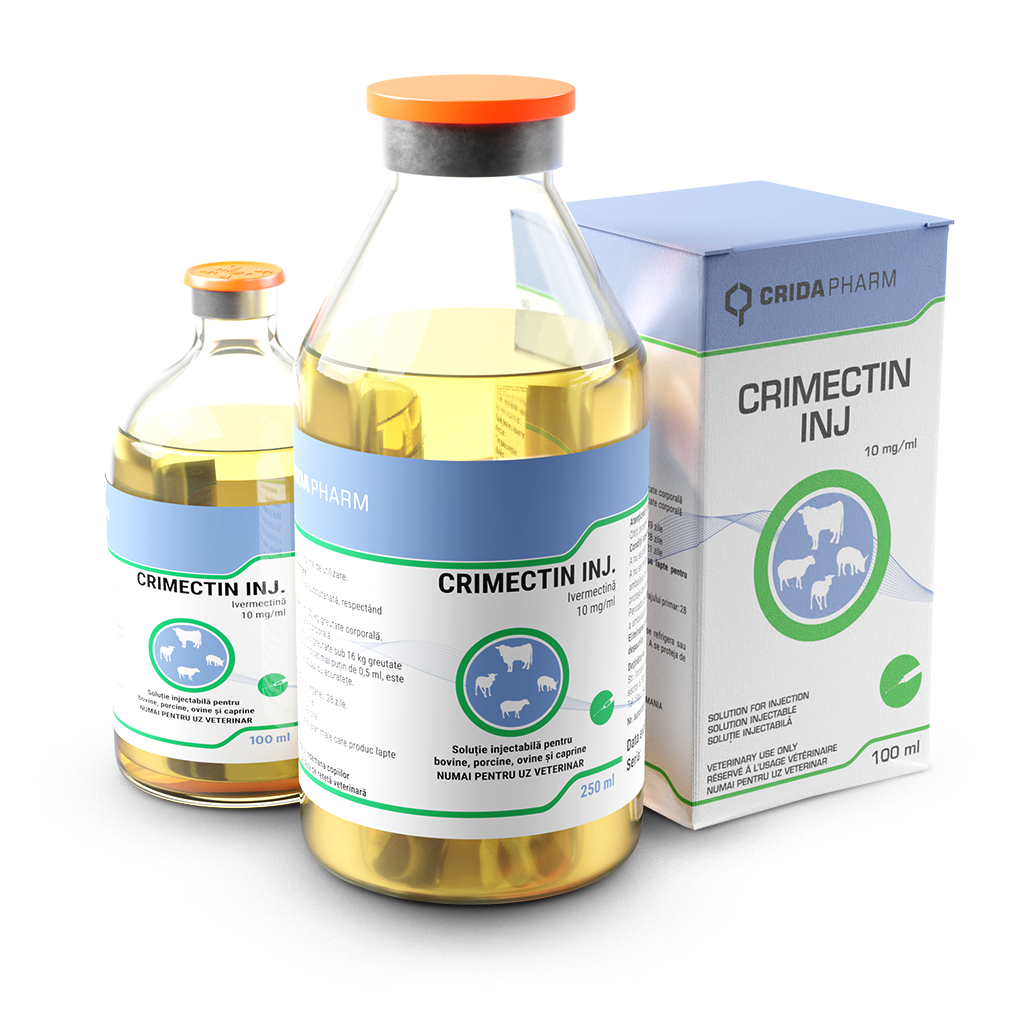
CRIMECTIN INJ.
100 ml
10 mg/ml solution for injection for equine cattle, pigs, sheep and goats
Composition:
1 ml of injection solution contains:
Active ingredient: Ivermectin..................................................10 mg
Indications: Used for both prophylaxis and treatment against endoparasites and ectoparasites:
Cattle: Gastrointestinal roundworms (adults and larvae), lungworms (mature and fourth-stage larvae), myiasis (all three stages of larvae), lice, ticks.
Sheep and goats: Gastrointestinal roundworms (adults and fourth-stage larvae), lungworms (adults and fourth-stage larvae), Dictyocaulus spp. (adults and fourth-stage larvae), myiasis (all larval stages); ticks (Sarcoptes spp., Psoroptes spp.).
Pigs: Gastrointestinal roundworms (adult and fourth stage larvae), lungworms (adult), lice, ticks.
The use of the product in the target species should take into account geographical differences in the distribution patterns of the parasites.
Contraindications:
Do not use intramuscularly or intravenously.
Do not use in animal species other than those listed above, as serious adverse reactions, including mortality, may occur in dogs.
Do not use in cases of known hypersensitivity to the active substance or excipients.
Adverse reactions:
Transient discomfort and a mild inflammatory reaction at the injection site are observed; these reactions disappear without treatment.
If you notice any adverse reactions, even those not listed in this leaflet, please inform your veterinarian.
Target animals: Cattle, pigs, sheep and goats.
Dosage, route and method of administration: Use subcutaneously only.
Cattle, sheep and goats: 1 ml/50 kg body weight, equivalent to 0.2 mg ivermectin/kg body weight.
Pigs: 1 ml/33 kg body weight, equivalent to 0.3 mg ivermectin/kg body weight.
In adult pigs, especially those weighing less than 16 kg, when administering less than 0.5 ml of the drug, it is especially important to determine the exact dosage.
Advice for correct use: General aseptic precautions must be observed.
If animals are to be treated collectively rather than individually, they should be grouped by body weight and the dose determined accordingly to avoid over- or under-treatment.
Withdrawal period:
Meat and offal:
Pigs and goats: 28 days.
Sheep: 21 days.
Cattle: 49 days.
Milk: Not permitted for use in lactating animals producing milk for human consumption.
Special precautions for storage:
Keep out of the reach and sight of children. Do not store above 25°C. Do not refrigerate. Do not freeze. Store away from direct sunlight.
Do not use after the expiry date stated on the label. Shelf life after first opening the package: 28 days.
Special precautions for each animal:
Precautions should be taken to avoid the development of resistance and ultimately ineffective treatment: Too frequent and repeated use of the same class of anthelmintic over a long period of time. Underdosing, which may be due to incorrect body weight assessment, incorrect use of the product or problems with the calibration of the dispenser (if applicable).
In case of suspicion of clinical resistance to anthelmintic drugs, this should be investigated by performing appropriate tests (e.g. faecal egg count reduction test). If the test results strongly indicate resistance to a specific anthelmintic drug, an anthelmintic drug belonging to a different pharmacological class and with a different mechanism of action should be used.
Special precautions for use in animals:
Do not use intramuscularly or intravenously. Ivermectin is highly effective against all larval stages of cattle tapeworms. However, timing of treatment is important. For best results, cattle should be treated as soon as possible after the bull tapeworm season has ended.
Occasionally, dead parasites (Hypoderma lineatum) that are present near the esophageal tissues may cause drooling and abdominal distension. Similarly, dead Hypoderma bovis in the spinal canal may cause balance disorders or paralysis. Cattle should be treated before the onset of the fly-eating stages or after the end of the fly-eating stages.
Special precautions to be taken by the person administering the medicinal product to animals:
People with known hypersensitivity to ivermectin should avoid contact with the product. Direct contact with skin and eyes should be avoided. If contact occurs, flush eyes and skin with plenty of water.
Do not eat or smoke when using the product.
Take care to avoid accidental self-administration: the product may cause local irritation and/or pain at the injection site.
Use during pregnancy or lactation:
The product may be administered to animals during pregnancy or lactation, but in this case the milk should not be used for human consumption.
The product should not be used in animals less than 28 days before calving and in animals producing milk for human consumption.
Interactions with other medicinal products and other forms of interaction:
None known.
Overdose:
Ivermectin is not toxic at 30 times the recommended dose. If a toxic reaction due to overdose is suspected, appropriate symptomatic treatment is recommended. Toxic symptoms due to overdose include tremors, convulsions and coma.
Incompatibilities:
None known.
Special precautions to be taken when disposing of unused products or waste materials derived from the use of such products.
Do not dispose of medical products via sewage system or household waste.
Pharmacotherapeutic group: Endectocides, macrocyclic lactones, avermectins.
ATCvet code: QP54AA01
Packaging:
100 ml type II glass vials, closed with a bromobutyl rubber stopper and an aluminium cap, placed in an individual cardboard box.
Marketing Authorisation Holder:
S.C. CRIDA PHARM S.R.L.
Str. Intrarea Vagonetului, Nr. 2, Bloc 101, Ap. 47, Parter, Sector 6, Bucharest, Romania.
Tel./Fax: +4021 430 4399, E-mail: office@cridapharm.ro
Manufacturer:
S.C. CRIDA PHARM S.R.L, Str. Stadionului, Nr. 1, Oltenița, Jud. Calarasi, Romania.
Tel./Fax: +4024 251 5005, E-mail: office@cridapharm.ro