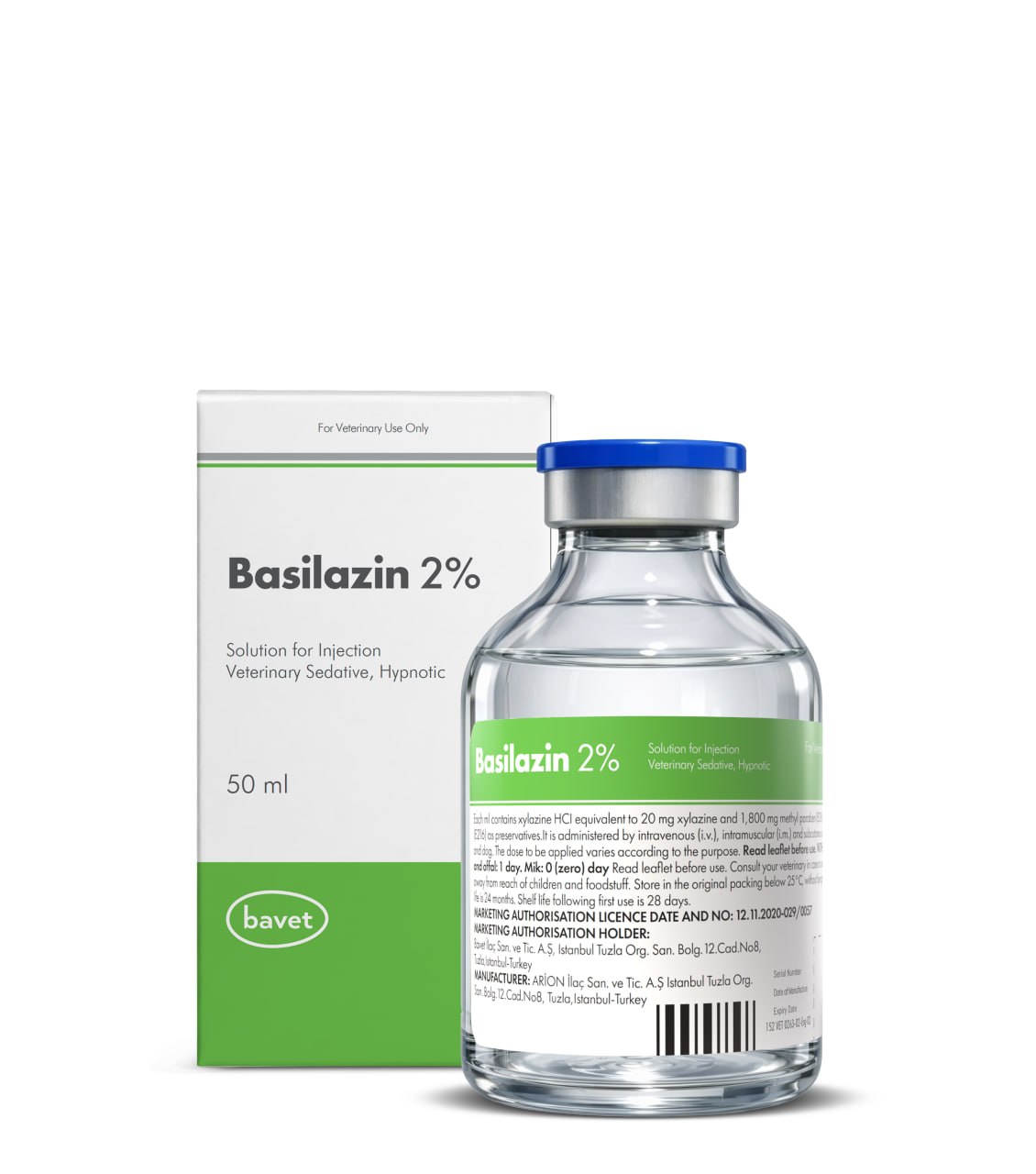
Basilazine 2% (BASILAZINE 2%)
For veterinary use only
Injection solution
Veterinary sedative and hypnotic drug
Composition
Basilazine 2% (Basilazine 2%) injection solution is a clear, colorless, sterile, particle-free solution containing 20 mg xylazine hydrochloride (HCl), 1800 mg methylparaben (E218), and 0.200 mg propylparaben (E216) as preservatives per ml. Veterinary ATC code: QN05CM92
Indications
Basilazine 2% is a sedative with analgesic and muscle relaxant properties used in cattle, horses, dogs, and cats when sedation is required, including:
1. When handling excited (nervous) animals, such as during transport.
2. During medical examinations, such as radiography, bandage removal, and examination of the genitals and oral cavity.
3. Premedication before minor superficial surgeries, as well as local or regional anesthesia.
4. To prevent defecation during examination and treatment of the vagina, uterus, and hind limbs.
Dosage and Administration
Cattle: The drug is administered intramuscularly. The dose is 0.05–0.3 mg/kg body weight (0.25–1.5 ml/100 kg), depending on the desired degree of sedation. Highly agitated (nervous) animals may require higher doses, not exceeding 0.3 mg/kg (dosing frequency 4 times daily).
Xylazine Dose
mg/kg body weight Xylazine mg/100 kg body weight Basilazine 2%
ml/100 kg body weight
1 0.05 mg 5 mg 0.25 ml
2 0.1 mg 10 mg 0.5 ml
3 0.2 mg 20 mg 1 ml
4 0.3 mg 30 mg 1.5 ml
Dose 1: Muscle relaxation, moderate sedation.
Dose 2: Analgesic effect with muscle relaxation; the animal can stand or lie down. Dose 3: Deep sedation, profound muscle relaxation, and a pronounced analgesic effect. The animal remains recumbent.
Dose 4: Very deep sedation, very deep muscle relaxation, and an analgesic effect. The animal remains recumbent.
Horses:
Administer by slow intravenous injection. The dose depends on the desired degree of sedation and the animal's response and ranges from 0.6–1 mg/kg body weight (3–5 ml/100 kg). Nervous or excited horses may require higher doses. Older horses and those with significant physical activity prior to treatment should be given the lowest dose. Horses are typically not recumbent, and this dose produces mild to profound sedation with varying degrees of analgesia. Effects typically occur within 5 minutes and last for approximately 20 minutes. 2% basilicin can be used in horses as a premedication (preoperative) before barbiturate anesthesia or in combination with regional or local anesthesia.
Dogs:
The drug is administered intramuscularly at a dose of 1–3 mg/kg (0.05–0.15 ml/kg body weight). It can be used in combination with local anesthesia. In some cases, premedication with atropine (preoperative preparation) may be desirable. The drug acts synergistically with barbiturates, reducing the latter's dosage by approximately half.
Cats:
The drug is administered intramuscularly at a dose of 3 mg/kg (0.15 ml/kg body weight). In some cases, premedication with atropine may be desirable. When used with ketamine, xylazine has a sedative effect, reducing muscle contractions due to its anesthetic effect. Barbiturate anesthesia should not be initiated until sedation is achieved (which occurs approximately 20 minutes after xylazine administration). Under these conditions, half the barbiturate dose may be used.
Side Effects
In general, side effects typical of α2-adrenergic agonists may occur, such as bradycardia, reversible arrhythmias, and hypotension. The drug may affect thermoregulation, and therefore body temperature may decrease or increase in response to environmental temperature. Respiratory depression and/or respiratory arrest may occur, especially in cats.
Withdrawal Period:
Cattle (meat and by-products): 1 day.
Cattle (milk): 0 days.
Contraindications:
The drug should not be administered to animals with known hypersensitivity to the active ingredients or excipients.
Since the muscle relaxant properties of the drug may aggravate obstructive symptoms and vomiting, it should not be administered to animals with gastrointestinal obstruction. This drug should not be administered to animals with renal failure, liver failure, respiratory failure, cardiac disease, hypotension, and/or shock. This drug is contraindicated in animals with diabetes. This drug should not be administered to animals prone to seizures. Do not use during the last trimester of pregnancy.