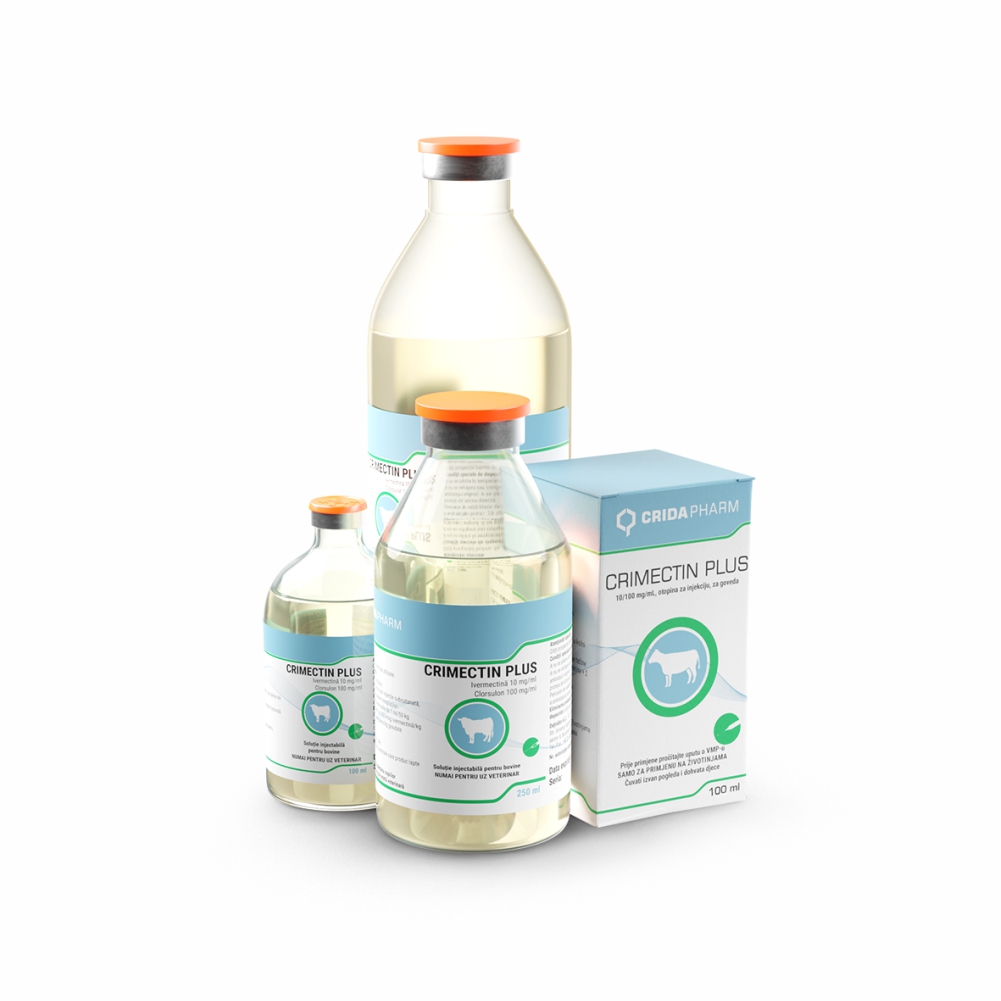
CRIMECTIN PLUS 10/100 mg/ml
Injectable solution for cattle
Qualitative and quantitative composition
Each milliliter contains:
Active substances:
Ivermectin (Ivermectin) …………………. 10 mg
Clorsulon (Clorsulon) …………………. 100 mg
Excipients:
Propylene Glycol
Glycerol Formal
Pharmaceutical form
Injectable solution. A clear, slightly viscous solution, the color of which varies from colorless to straw-colored.
Target species: cattle.
Indications for use specifying the target species
The product “Crimectin Plus” is recommended for the control (after confirmation of diagnosis) and treatment of the following parasitic infestations:
Gastrointestinal roundworms
Ostertagia ostertagi (adult, L4 and L3 stages, including inhibited larval stages)
Ostertagia lyrata (adult and L4 stage)
Haemonchus placei (adult, L4 and L3 stages, including inhibited larval stages)
Mecistocirrus digitatus (adult stage)
Trichostrongylus axei (adult and L4 stages)
Trichostrongylus colubriformis (adult and L4 stages)
Cooperia spp. (adult, L4 and L3 stages)
Cooperia oncophora (adult and L4 stages)
Cooperia punctata (adult and L4 stages)
Cooperia pectinata (adult and L4 stages)
Nematodirus helvetianus (adult stage)
Nematodirus spathiger (adult stage)
Strongyloides papillosus (adult stage)
Bunostomum phlebotomum (adult, L4 and L3 stages)
Toxocara vitulorum (adult, L4 and L3 stages)
Oesophagostomum radiatum (adult, L4 and L3 stages)
Trichuris spp. (adult stage)
Eye worms
Thelazia spp. (adult stage)
Lungworms
Dictyocaulus viviparus (adult, L4 stages, including larval stages)
Subcutaneous parasites
Hypoderma bovis
Hypoderma lineatum
Dermatobia hominis (all larval stages)
Myiasis
Chrysomya bezziana
Cochliomyia hominivorax
Sucking lice
Linognathus vituli
Haematopinus eurysternus
Solenopotes capillatus
Mites
Psoroptes ovis
Sarcoptes scabiei
Ticks
Ornithodoros savignyi
Boophilus microplus
Boophilus decoloratus (resistant to organophosphorus compounds, synthetic pyrethroids and amidines)
Liver flukes
Fasciola hepatica
Fasciola gigantica (adult and immature stages)
Crimectin Plus, administered at the recommended dose of 1 ml per 50 kg body weight, provides protection against reinfection as follows: Haemonchus placei, Trichostrongylus axei, Cooperia punctata, Cooperia oncophora and Cooperia surnabada, with which reinfection may occur within 14 days after the first treatment; Ostertagia ostertagi and Oesophagostomum radiatum, with which reinfection may occur within 21 days after the first treatment; and Dictyocaulus viviparus, with which reinfection may occur within 28 days after the first treatment.
The product Crimectin Plus prevents the invasion of Chrysomya bezziana larvae. The product is effective against larvae up to 2 days old. Mature larvae remain resistant for 3 or more days after treatment. Crimectin Plus may be used for prophylactic purposes during planned procedures such as castration and ear tagging, as well as to prevent infestation with Chrysomya bezziana for up to 14 days after treatment.
For the prevention of umbilical myiasis in newborn calves, Crimectin Plus should be administered no later than 24 hours after birth. After castration, male calves should be treated immediately. All animals treated at birth or after castration should be inspected daily until complete healing of the wounds. If necessary, a local insecticide may be used.
Contraindications
Do not use intravenously or intramuscularly. Do not use in animals with hypersensitivity to the active ingredients or excipients.
Special warnings for each target species
Care should be taken to avoid the following practices, as they increase the risk of development of resistance and may ultimately lead to treatment failure: frequent and repeated use of anthelmintics from the same class over a long period of time; underdosing, which may be due to incorrect estimation of body weight, improper administration of the product or lack of calibration of the dosing device (if any). Suspected clinical cases of resistance to anthelmintics should be further investigated using appropriate tests (e.g. fecal egg count reduction test). If the test results clearly indicate resistance to a particular anthelmintic, a product from a different pharmacological class with a different mechanism of action should be used. Resistance to macrocyclic lactones (including ivermectin) has been reported in Cooperia spp. in cattle in the European Union and outside the EU. Therefore, the use of this product should be based on local (regional, farm-level) epidemiological information about nematode susceptibility and recommendations on how to limit further development of resistance to anthelmintics.
Special precautions for use in animals
To reduce potential discomfort or local reactions, doses greater than 10 ml should be divided between two injection sites. When administering other parenteral medicinal products simultaneously, different injection sites should be used.
The product should be used only in the target species in accordance with the instructions in the package leaflet. The product should be administered only subcutaneously, in the loose skin in front of or behind the shoulder, using any standard automatic device or a single-dose injection device calibrated for administration. Use only dry, sterile needles.
Special precautions to be taken by the person administering the veterinary medicinal product to animals
Do not eat, drink or smoke while handling the product. Wash hands thoroughly after use. Avoid direct contact of the product with skin or eyes. In case of contact with eyes, rinse with plenty of water. Take special care to avoid accidental self-injection: the product may cause local irritation and/or pain at the injection site. In case of accidental self-injection, seek medical advice immediately and show the package leaflet or label to the physician.
Adverse reactions (frequency and seriousness)
Some animals may show transient discomfort after subcutaneous injection. In rare cases, mild inflammatory reactions at the injection site have been observed, which resolve without treatment.
Use during pregnancy, lactation
When used at the recommended dose, the product does not affect reproductive function. The product may be used in beef cattle during pregnancy and lactation; however, milk from treated animals must not be used for human consumption.
Interaction with other medicinal products and other forms of interaction
None known.
Amounts to be administered and route of administration
The recommended dose is 1 ml per 50 kg body weight (corresponding to 200 µg ivermectin plus 2 mg clorsulon per kg body weight). The product should be administered only subcutaneously in the loose skin in front of or behind the shoulder. A sterile 16-gauge (15–20 mm) needle is recommended. Administration of the product at temperatures below 5°C may be difficult due to increased viscosity. Warming the product and injection equipment to approximately 15°C will facilitate administration. To ensure correct dosing, body weight should be determined as accurately as possible and the accuracy of the dosing device should be checked.
Treatment program in regions with Hypoderma spp.
Ivermectin is effective against all larval stages of Hypoderma spp. For best results, treatment should be carried out as soon as possible after the end of the fly activity period. Although not directly related to ivermectin, the death of Hypoderma larvae during migration through vital areas may cause serious reactions in infected animals. For example, death of Hypoderma lineatum larvae in the esophageal tissues may cause bloat or intestinal obstruction. Death of Hypoderma bovis larvae during migration through the spinal canal may cause paralysis. Therefore, treatment should be carried out before or after the larval migration period. After the end of the fly season (in September), a second treatment with ivermectin may be administered during winter to control internal parasites, ticks and lice, as well as to eliminate Hypoderma larvae.
Overdose (symptoms, emergency procedures, antidotes), if necessary
Safety studies have shown a high margin of safety. Administration of 25 ml per 50 kg body weight resulted in lesions at the injection site (tissue necrosis, swelling, fibrosis and inflammation). No other adverse reactions related to the product were observed.
Withdrawal periods
Meat and offal: 66 days
Milk: not permitted for use in animals producing milk for human consumption.
Pharmacotherapeutic group: endectocides, avermectins, ivermectin combinations.
ATCvet code: QP54AA51.
Pharmaceutical particulars
Incompatibilities: in the absence of compatibility studies, this veterinary medicinal product must not be mixed with other veterinary medicinal products.
Shelf life
Shelf life of the veterinary medicinal product as packaged for sale: 2 years.
Shelf life after first opening: 28 days.
Special precautions for storage
Do not store above 25°C. Do not refrigerate. Protect from freezing. Store in the original package. Store in a dry place. Protect from direct sunlight.
Special precautions for the disposal of unused veterinary medicinal product or waste materials derived from such products
Any unused veterinary medicinal product or waste materials should be disposed of in accordance with local requirements.
Marketing authorization holder
CRIDA PHARM S.R.L.
Str. Intrarea Vagonetului, Nr. 2, Bloc 101, Ap. 47, Parter, Sector 6,
Bucharest, Romania
Tel/Fax: +4021 4304399
E-mail: office@cridapharm.ro